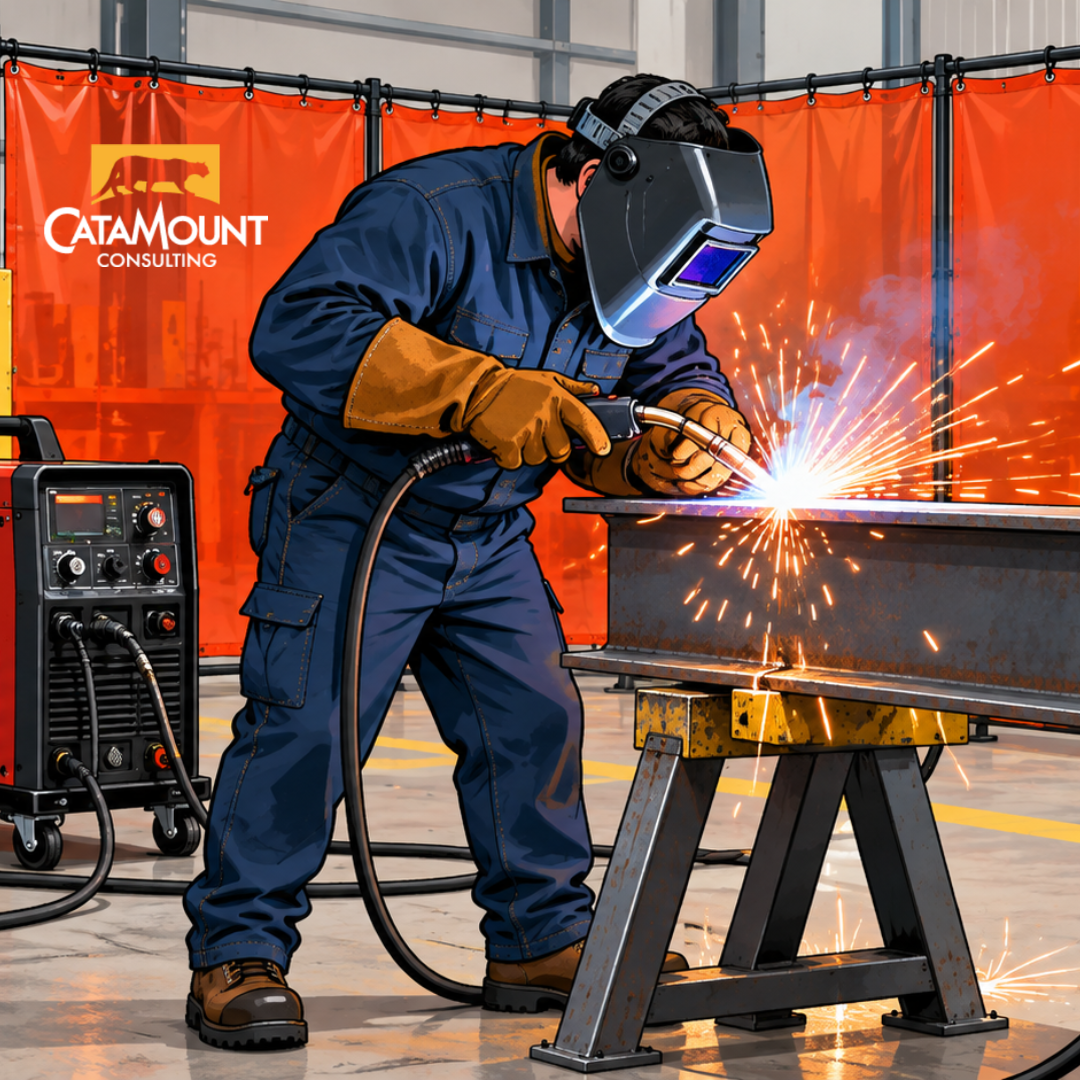
What Is Hot Work? Understanding the Risk Before the Work Begins
Hot work is a routine part of construction, manufacturing, maintenance, mining and many other industrial environments. But when a task involves flames, sparks, or even a familiar job can create serious hazards if the surrounding work area is not properly evaluated.
Because these tasks are often familiar, it can be easy to focus on the person doing the work and overlook the conditions around them. Some of the greatest risks may be found beyond the immediate work area—in nearby combustible materials, concealed spaces, process equipment, or areas where flammable vapors may be present.
A grinder used in a designated work area is very different from spark-producing work near combustible materials, process equipment, flammable vapors, or an enclosed space. The task may be the same, but the level of risk can change dramatically depending on the environment.
At Catamount, we believe effective safety starts with looking at the bigger picture. When it comes to hot work, the question isn’t just, “What is the worker doing?” It’s also, “What could this task ignite, damage, or expose?”
What Counts as Hot Work?
Hot work commonly includes welding, cutting, brazing, soldering, grinding, heating, and other operations capable of producing flame, sparks, or significant heat. OSHA
For both general industry and construction, fire prevention is built around a simple idea: separate the ignition source from anything that can burn.
Whenever possible, move the object being worked on to a designated area where fire hazards can be controlled. If the object cannot be moved, remove nearby combustible materials or protect them with appropriate safeguards. If those hazards cannot be adequately controlled, the work should not proceed. OSHA
This is why hot work safety involves much more than the person holding the welding torch or grinder. The entire work area—and anything that could be affected by the work—must be considered
Why Is Hot Work Dangerous?
Fire is the obvious concern, but the way fire develops is not always obvious.
Sparks can travel through floor openings, wall openings, doorways, and windows. Heat can transfer through metal walls, ceilings, roofs, and partitions. Ductwork and conveyors can carry sparks into areas that are nowhere near the person performing the work. OSHA
A work area that appears safe at first glance may still contain hidden hazards. Combustible materials could be located on the opposite side of a wall, beneath the work surface, or inside equipment that previously contained flammable substances. OSHA
Hot work can also create other serious worker hazards, including:
- Fire and explosions: Sparks or heat can ignite combustible materials, flammable vapors, or dust.
- Hazardous fumes and gases: Welding and cutting can expose workers to airborne contaminants that require appropriate controls.
- Burns and radiant energy: Workers may be exposed to hot materials, molten metal, sparks, and intense light.
- Electrical hazards: Welding equipment and related tools can introduce electrical risks if not properly maintained and used.
- Poor ventilation: Enclosed or restricted spaces can allow hazardous fumes or gases to accumulate.
Recognizing these hazards before work begins is essential to selecting the right controls and protecting everyone who could be affected. Appropriate eye protection, protective clothing, and ventilation are part of the overall control strategy. OSHA
Start With the Work Area
Before hot work is authorized, the area should be inspected, potential hazards identified, and the required precautions identified.
That assessment needs to go beyond what is immediately visible. Consider what is nearby, what may be concealed, and what could change once the work begins.
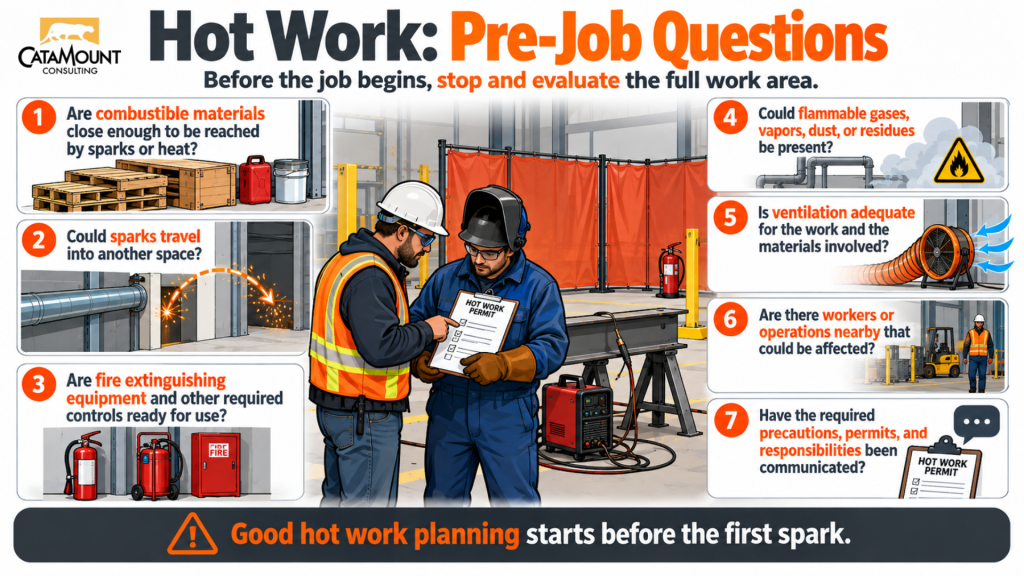
Questions worth asking include:
- Are combustible materials close enough to be reached by sparks or heat?
- Could sparks travel into another space?
- Are fire extinguishing equipment and other required controls ready for use?
- Could flammable gases, vapors, dust, or residues be present?
- Is ventilation adequate for the work and the materials involved?
- Are there workers or operations nearby that could be affected?
- Have the required precautions, permits, and responsibilities been communicated?
Fire-extinguishing equipment must be readily available as required by the applicable OSHA standard. The specific precautions needed will depend on the work being performed, the surrounding conditions, and the hazards identified during the assessment. OSHA
Taking a few extra minutes to evaluate the work area can help prevent an incident that could otherwise affect an entire facility.
The 35-Foot Rule
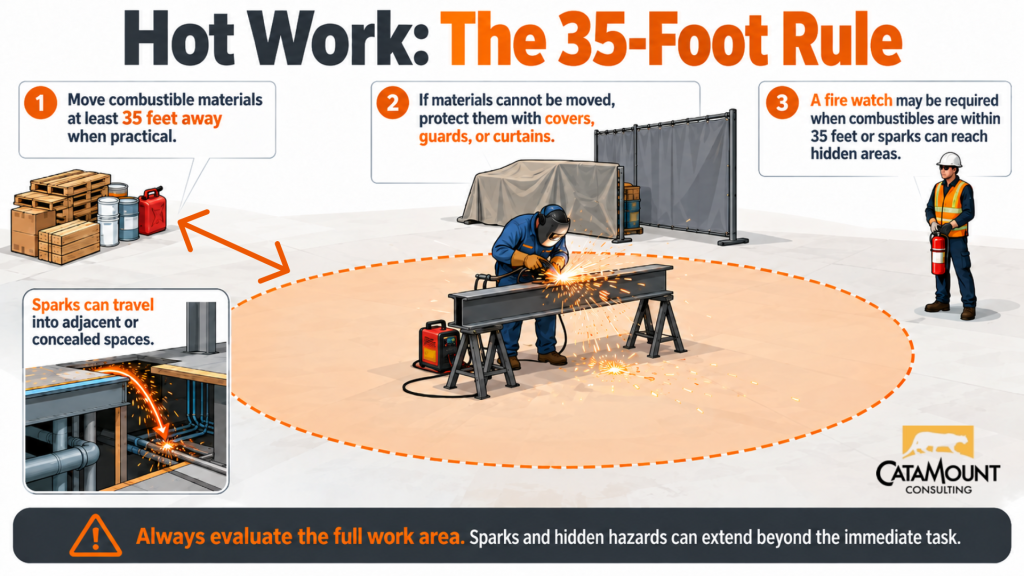
One of the most useful distances to remember when planning hot work is 35 feet.
Under the general industry standard, fire-watch requirements can be triggered when appreciable combustible material is within 35 feet of the work. A fire watch may also be needed when combustibles are farther away but can still be ignited by sparks, or when openings within that radius expose combustible materials in concealed or adjacent spaces. OSHA
Where practical, combustibles should be relocated at least 35 feet from the work area. If they cannot be moved, they should be protected with appropriate covers, shields, guards, or curtains. OSHA
However, 35 feet should not be treated as an automatic guarantee of safety. Sparks can travel farther, and hidden hazards may exist beyond the immediate work zone. The conditions of the specific job must determine the precautions needed.
The key takeaway? The hazard zone can be much larger than the area where the torch, welder, or grinder is operating.
When Is a Fire Watch Needed?
A fire watch becomes especially important when the work area cannot be made completely free of fire hazards.
The fire watch should have extinguishing equipment available, know how to use it, and understand how to sound an alarm if a fire develops. In general industry, the fire watch must remain in place for at least 30 minutes after welding or cutting is complete to detect possible smoldering fires. OSHA
Construction requirements use slightly different language, but the principle is similar: additional personnel may be needed when normal fire-prevention measures are not enough, and they must remain long enough after the work to make sure a fire does not develop. OSHA
Where Do Hot Work Permits Fit In?
A hot work permit helps establish a clear process for evaluating hazards and confirming that required precautions are in place before work begins.
OSHA’s general industry standard calls for the area to be inspected by the person responsible for authorizing cutting and welding operations, with authorization preferably provided through a written permit.
Depending on the employer’s procedures and the job’s requirements, a hot work permit may document:
- The location and description of the work
- Identified fire, explosion, and other hazards
- Required precautions and protective measures
- Fire-extinguishing equipment and fire-watch responsibilities
- Authorization to begin work
- Required post-work monitoring
A permit should be more than a form to complete or a signature to collect. It should serve as a deliberate checkpoint that prompts workers and supervisors to stop, evaluate the conditions, and address hazards before the job begins.
The value of a hot work permit lies in the quality of the hazard assessment—not simply in having a piece of paper on file.
Containers and Enclosed Spaces Need Extra Attention
Tanks, drums, barrels, piping, and other containers can present serious hazards during hot work, even when they appear empty.
Flammable residues or vapors may remain inside equipment that previously held fuel, chemicals, or other combustible materials. Introducing heat or sparks can ignite those residues and potentially cause a fire or explosion.
Before hot work is performed on used containers or equipment, appropriate cleaning and preparation must be completed. Hollow spaces and containers must also be properly vented when required to prevent dangerous pressure buildup during heating, cutting, or welding.
Additional precautions may be necessary when work involves confined spaces or areas with limited ventilation.
Never assume a container is safe simply because it has been emptied. Its previous contents, current condition, and preparation for hot work must all be considered before the job is authorized.
Supervisors Play a Critical Role
Safe hot work depends on more than the welder or cutter. Safe hot work is a shared responsibility. The OSHA general industry standard assigns supervisors responsibility for identifying combustible materials and hazardous areas, protecting those materials from ignition, securing authorization, confirming that conditions are safe, and making sure required fire protection is available. OSHA
That is an important part of the prevention process.
Responsibilities may include identifying combustible materials and hazardous areas, ensuring that fire hazards are removed or protected, obtaining the necessary authorization, verifying that conditions are safe, and confirming that required fire protection is available.
Supervisors should also make sure workers understand the hazards, the precautions required, and what to do if conditions change during the job.
At Catamount, we see this as a systems issue. Strong safety performance comes from how work is planned, authorized, communicated, and carried out in the field. When supervisors take an active role in these steps, they help build a workplace where employees are better prepared to recognize and address hazards before an incident occurs.
Hot Work Safety Starts Before the First Spark
Hot work risk is rarely limited to the task itself.
The real picture includes where sparks can travel, what heat can reach, what hazards may be hidden nearby, and whether the surrounding conditions have changed since the job was planned.
That is where prevention begins.
At Catamount Consulting, we help organizations across construction, mining, and general industry strengthen hazard recognition, improve work-planning systems, and identify risk earlier in the process.
With hot work, the best opportunity to prevent an incident often comes before the torch is lit or the grinder starts. Careful planning, a clear understanding of the work area, and the right controls give teams a better chance to catch hazards before the job begins and protect their people, their facilities and their operations.